

Voter Turnout
Key Messages
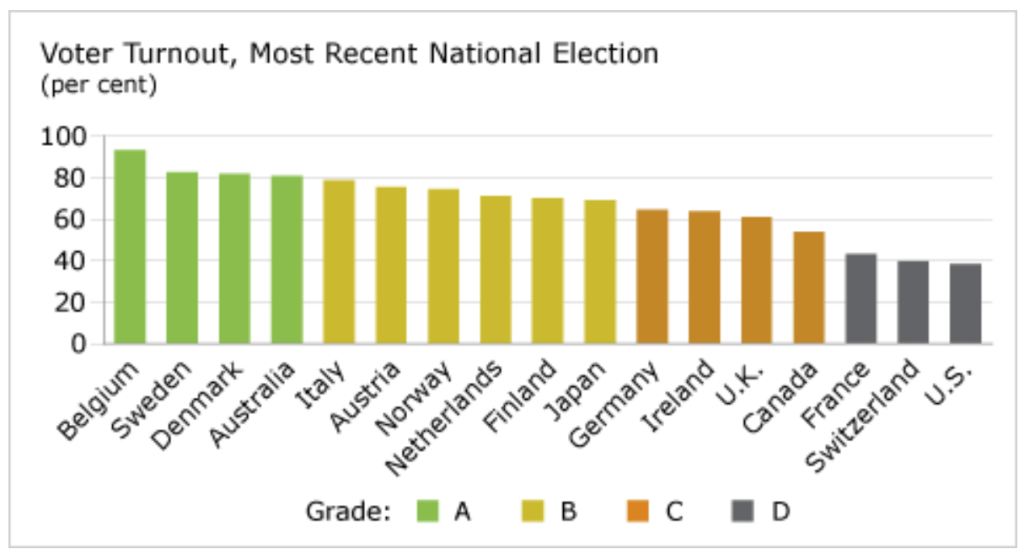
- Canada scores a “C” and ranks 14th out of 17 peer countries.
- Only 53.8 per cent of adult Canadians voted in the 2011 federal election—the second-lowest turnout in history.
- The decline in voter turnout in Canada may be due to lower participation of young people.
Putting voter turnout in context
One indicator commonly used to measure social cohesion is the proportion of individuals who participate in the political system. Determining the underlying influences of declining voter turnout rates can be difficult: A low turnout may be due to disillusionment or indifference, or even complacent satisfaction with the way the country is being governed. Conversely, a high turnout rate may reflect compulsory voting laws (as in Australia and Belgium) or coercion.
Voter turnout therefore may not always be a reliable indicator of social cohesion. The vast majority of analysts, however, consider a high voter turnout to be preferable to a low turnout because it means that the government will more likely reflect the interests of a larger share of the population.
Low voter turnout implies that the democratic system may not be reflecting the interests of all citizens. Voter turnout tends to be lowest among youth, those who are less educated, and those in lower income brackets.
How does voter turnout in Canada compare to that of its peers?
Voter turnout rates—the percentage of eligible voters who cast ballots in national elections—vary markedly across the peer countries, from a high of 93 per cent in Belgium, to a low of 38 per cent in the United States. Canada rates a “C” on this indicator, with 53.8 per cent of Canadians voting in the 2011 election.
Why is voter turnout declining in Canada?
Fewer Canadians are voting now than in the past. Voter turnout declined to its second-lowest rate—53.8 per cent—in Canada during the 2011 federal election. This was only slightly higher than the 53.6 per cent in 2008. A survey conducted for Elections Canada after the 2008 election found that 57 per cent of those who didn’t vote cited reasons termed “everyday situations”— being on holiday, being too busy, family obligations, or work schedules.1 Fifty-four per cent of them said they would vote if they could do so online. In response, Elections Canada has said that it will push for legislative changes that would allow the implementation of online registration of voters, and it wants parliamentary approval to conduct a test-run of the electronic process in a by-election by 2013.2
An earlier study for Elections Canada noted the decline in voter turnout in recent elections is mainly due to lower participation of young people, and that “it is part of a demographic trend that shows every sign of continuing well into the future.”3 In 2011, only 38.8 per cent of the population aged 18 to 24 voted.
The report offered a number of ways to increase voter participation among young people, including:
- making voting easier and more meaningful for first-time voters
- making politics more relevant to the young
- providing them with the tools they need to understand its relevance to their own lives
- engaging them more directly in the political process
But there is a caveat. The report concluded, “without fundamental changes in the way in which politics is conducted in Canada, these are goals that could well remain out of reach for some time.”4
Like Canada, most of the peer countries have also experienced a decline in voter turnout.
Has Canada improved its relative grade?
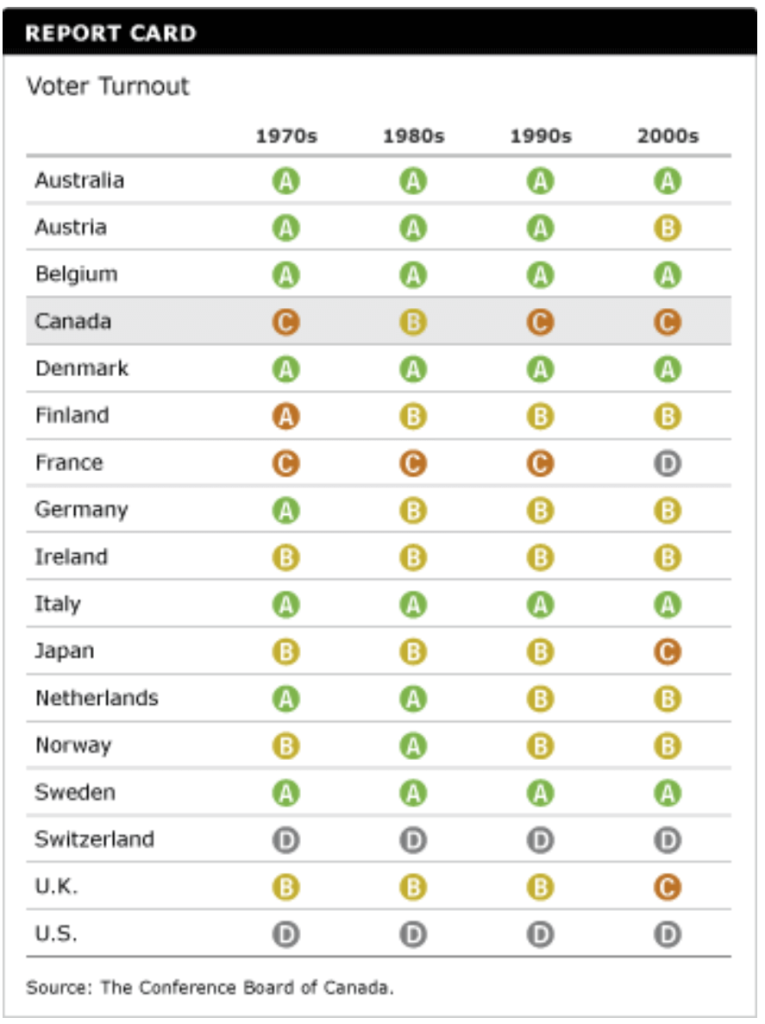
Canada has not managed to improve its relative grade. It earned a “C” grade in the 1990s and 2000s.
Is compulsory voting a good thing?
The Australian system of compulsory voter attendance began in 1924. Voters are obliged to attend the polling station, but they can leave without voting after ticking their names off, which partly explains why the Australian voting rate is less than 100 per cent. Non-attendees face a fine of AU$20.5
Critics of the system question whether it is “democratic” to use financial or social sanctions to compel citizens to turn out to vote.6 Supporters maintain that compulsory voting removes socio-economic status turnout biases. They also argue that, in a nation like Australia built on immigration, compulsory voting is a symbol of “the integration of new arrivals into the Australian way of doing things.”7
The very low Swiss voter turnout rate (40 per cent) reflects citizen perception that voting has little impact on how the country is run, according to political scientist Mark Franklin.8 Switzerland’s administration is highly decentralized, and the federal government has limited powers. The government invariably consists of a coalition of parties, and the serious issues are placed before the population in referendums.
Voter fatigue is another reason cited for low Swiss voter turnout—it is not unusual for a Swiss citizen to be asked to go to the polls as many as 10 times in a single year for a variety of national and local elections, as well as referendums.9
Footnotes
1 Elections Canada, Report on the Evaluations of 40th General Election (Ottawa: Elections Canada, 2009), 14 (accessed August 31, 2009).
2 The Canadian Press, “Elections Canada Advocates Online Voting to Increase Turnout,” June 27, 2009 (accessed August 31, 2009).
3 Jon H. Pammett and Lawrence LeDuc, “Confronting the Problem of Declining Voter Turnout Among Youth,” Electoral Insight, July 2003 (accessed August 31, 2009).
4 Jon H. Pammett and Lawrence LeDuc, “Confronting the Problem of Declining Voter Turnout Among Youth,” Electoral Insight, July 2003 (accessed August 31, 2009).
5 Australian Electoral Commission, “Voting Within Australia—Frequently Asked Questions: What Happens if I Do Not Vote?” Australian Electoral Commission (accessed August 31, 2009).
6 Simon Jackman, “Compulsory Voting,” International Encyclopedia of the Social and Behavioral Sciences (Elsevier: Oxford, U.K., 2001).
7 Elliot Franka, “Compulsory Voting Around the World,” The Guardian, July 4, 2005 (accessed August 31, 2009).
8 Mark N Franklin, “Electoral Engineering and Cross National Turnout Differences,” British Journal of Political Science, 29, 1 (January 1999), 211.
9 Shaun Major, “To Vote or Not to Vote? Compulsory Voting in Australia,” Discussion paper, Western Australian Electoral Commission, 1995, 23.