


Tech Checkup
Dealing With Technology Change in Pandemic Recovery
Since the onset of the pandemic, a large swath of Canada’s workforce has been working remotely.
This means employees are removed from the support of the office.
How have technology leaders been preparing their organizations for this new way of working? Are our cyber strategies keeping up?
The Conference Board of Canada surveyed 683 IT leaders and practitioners to understand how Canadian organizations are handling the pandemic. This is what we learned.
Note: Survey responses were collected between August 31 and September 10, 2020. This survey is part of a series to understand how Canadians are leveraging technology in the pandemic.
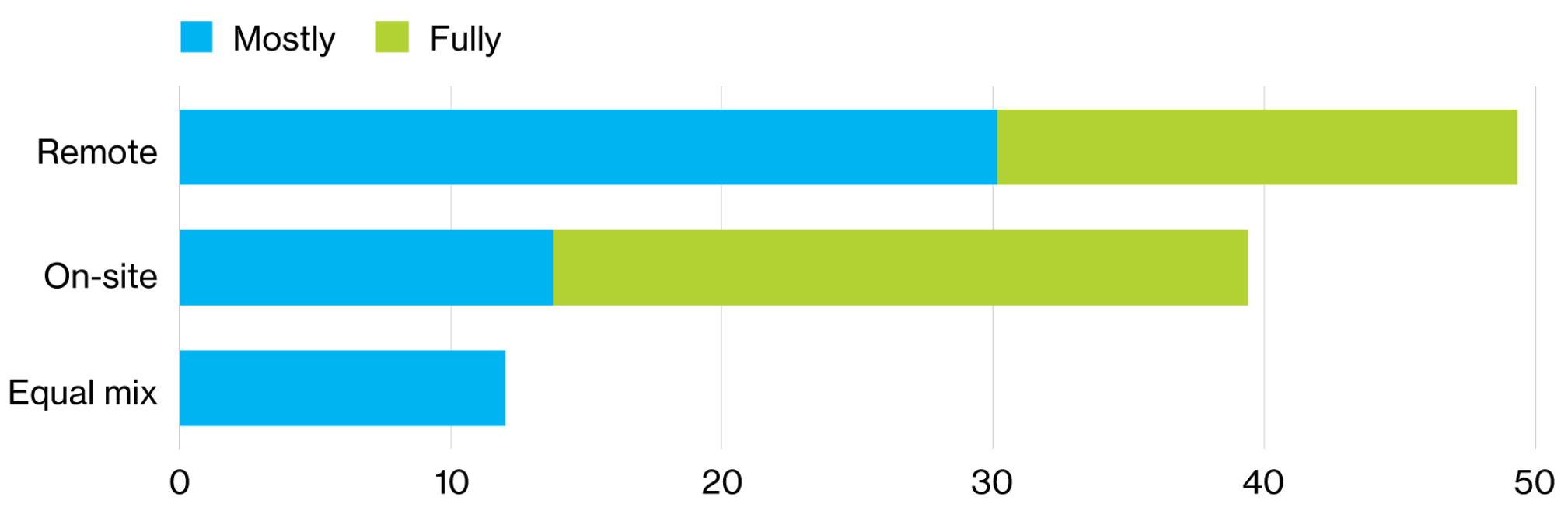
Almost half of respondents say their knowledge workforce is now fully or mostly remote
Q: Which best describes the current state of your organization’s workers who were on-site before the pandemic?
(percentage of respondents; n = 683)
Source: The Conference Board of Canada.
This is more evident in some industries and less in others
(n = 683; percentage of organizations)

Source: The Conference Board of Canada.
Cyber threats
Respondents were split on their staff’s awareness of cyber threats, but most seem confident in employees’ ability to recognize risks.

Most respondents believe their workforce has a foundational or better understanding and awareness of cyber threats
Q: How would you categorize the overall awareness of cyber threats in your workforce?
(percentage of respondents; n = 487)

Source: The Conference Board of Canada.
Still, 15% of respondents said their workforce doesn’t know enough about cyber threats. This is a gap that only education can fill.
Most respondents have not noticed an increase in threats
Q: Have you noticed an increase in reported cyber attacks, insider threats, or data breaches since the pandemic began?
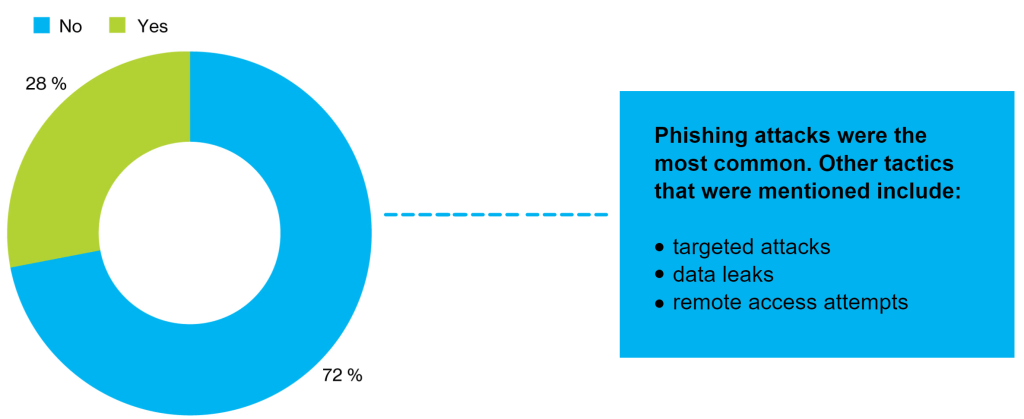
(percentage of respondents; n = 566)
Source: The Conference Board of Canada.

While organizations like the Canadian Anti-Fraud Centre and the Canadian Centre for Cyber Security have drawn attention to COVID-19-related threats, this may represent a change in the approach threats take, rather than an increase in frequency. It may also explain why most organizations we engaged have not changed their risk tolerance.
Risk tolerance for cyberattacks and data breaches has largely remained the same
Q: Have you made any changes to your risk tolerance for cyberattacks and data breaches?
(percentage of respondents; n = 566)

Source: The Conference Board of Canada.
Organizations are split almost evenly on adopting new technology.
Still, many organizations have accelerated their technology adoption because of COVID-19
Q: Has your organization accelerated its technology adoption (e.g., mass emergency messaging services, digital signatures) because of COVID-19?
(percentage of respondents; n = 469)

This is especially true for public administration organizations (74% of respondents)
(percentage of respondents; n = 469)

Organizations want to keep in touch with their remote workforce. By far, the most commonly reported technologies were remote collaboration software (e.g., video conferencing, instant messaging) and digital signatures. This was followed by virtual private network (VPN) and cloud technologies for file sharing.
However, respondents from organizations that have accelerated their technology adoption were also more likely to say that they’ve noticed an increase in reported cyber attacks.


Cybersecurity: what steps are organizations taking?
Organizations want to make sure their employees are who they say they are. The top three steps taken to protect against insider threats all involve making sure that only those who need access have access.
Multi-factor authentication is by far the most common approach to guard against insider threats from remote workers
Q: Which steps has your company/organization taken to guard against insider threats from remote workers? (please select all that apply)
(percentage of respondents; n = 487)

Source: The Conference Board of Canada
While half of our respondents indicated they have a managed security service provider to help their retail operations, 44% don’t have one and don’t plan to acquire one. This could be due to a number of reasons. They could be confident in their current systems, or they could be mitigating expenses during an uncertain time.
Half of respondents have a managed security service provider to support retail operations
Q: Does your organization have a managed security service provider (MSSP) supporting retail operations, particularly for managed detection and response (MDR)?
(percentage of respondents; n = 566)


Get to know our respondents.
Questions?